
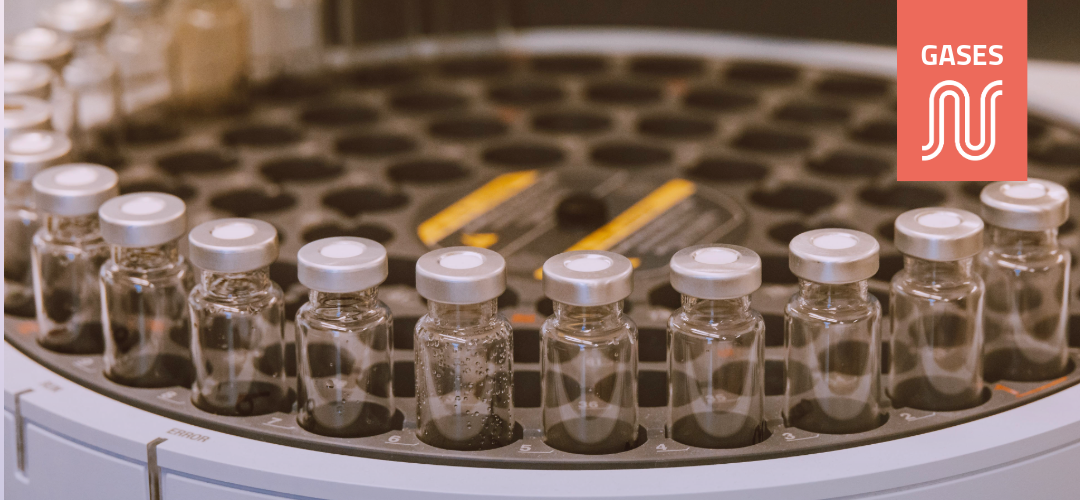
Knowing the boiling point distribution of a stabilized crude oil is important for its marketing, scheduling and processing. Simulated distillation with gas chromatography technique is the standard way to obtain it, but a full distribution is only as good, as its lightest end.
ASTM D7169 (IP 545) gives the boiling point distribution of crude oils and residues. However, in the light ends portion of the distribution, and in the mass recovery of the whole crude, it can be affected by significant errors due to interference from the diluent solvent. This is where the light components, the most volatile ones, are hardest to quantify. ASTM D7900 is often combined with D7169 to cover this part.
Traditionally, the sub-ambient temperatures needed for these analyses rely on cryogens. Their use brings high operating costs, safety risks and logistical complexity. The Climachrom2000 GC accessory removes these barriers, giving laboratories a cryogen-free way to reach the sub-ambient temperatures that light-end analyses such as ASTM D7900 require, while maintaining thermal stability.
It determines the boiling range distribution of hydrocarbons in stabilized crude oil up to and including n-nonane. A stabilized crude oil is defined as having a Reid Vapor Pressure equal to or lower than 82.7 kPa. Its results can be combined with those of D7169 to obtain a full boiling point distribution: D7900 for the front end, D7169 for the rest, merged into a single report.
Typical requirements for the GC system are:
The components covered by D7900 are among the most volatile in the sample. Working with them is easier when the oven can start well below ambient temperature.
Climachrom2000 reaches -20 °C through an integrated cooling system: the cooling is part of the instrument, with no cryogenic gas to supply, store or consume. In practice, this means:
Adopting Climachrom2000 for ASTM D7900 analysis offers tangible benefits over the traditional LN₂ approach. In our experience with similar sub-ambient analyses, the modulated cooling provides high-quality temperature control, which supports retention time reproducibility and, consequently, the accuracy of weight distribution calculations.
The system works with a closed-loop circuit installed in the GC oven. Dedicated software monitors the GC signals and automatically controls the flow through the circuit, cooling and controlling the oven exactly as the method requires. In the case of D7900:
| Feature | Traditional Cryogenic System (LN₂/LCO₂) | Climachrom 2000 (Redshift) |
| Cooling Medium | Disposable cryogenic gases (consumables) | Closed-loop gas |
| Minimum Temperature | Depends on gas (down to -190°C with LN₂) | Down to -20 °C (sufficient for C1–C9) |
| Operating Costs | High (gas purchase and logistics) | Reduced (no gas refills, very low maintenance) |
| Safety | Cryogenic and high-pressure risks | Safe system |
| Maintenance | Frequent ice/dry ice cleanup | No ice or dry ice formation |
| Environmental Impact | Resource consumption and gas transport | Minimal impact (F-gas in the circuit, no dispersion) |
Technological advances in gas chromatography allow laboratories to move away from cryogen-based cooling, with experience from similar analyses showing high-quality temperature control. The light ends are where a crude oil distribution is hardest to get right: ASTM D7900 addresses them, and an oven that starts at -20 °C without consuming cryogens makes this analysis easier to manage.
To learn more about Climachrom2000: https://redshift.it/gases/climachrom-2000/
Sources:
ASTM D7900, Standard Test Method for Determination of Light Hydrocarbons in Stabilized Crude Oils by Gas Chromatography.
ASTM D7169 (IP 545), boiling point distribution of samples with residues by high-temperature gas chromatography.


